> ## Documentation Index
> Fetch the complete documentation index at: https://overmind-b84ae13c-codex-workshop-queue-capacity.mintlify.site/llms.txt
> Use this file to discover all available pages before exploring further.
# Agent & Capabilities
> How Overmind models your agent — one graph per project, made of capabilities discovered by a local scan, described by agent-authored cards, and confirmed by telemetry.
export const Ascii = ({lines, cols}) => line.length))
}}>
{lines.join("\n")}
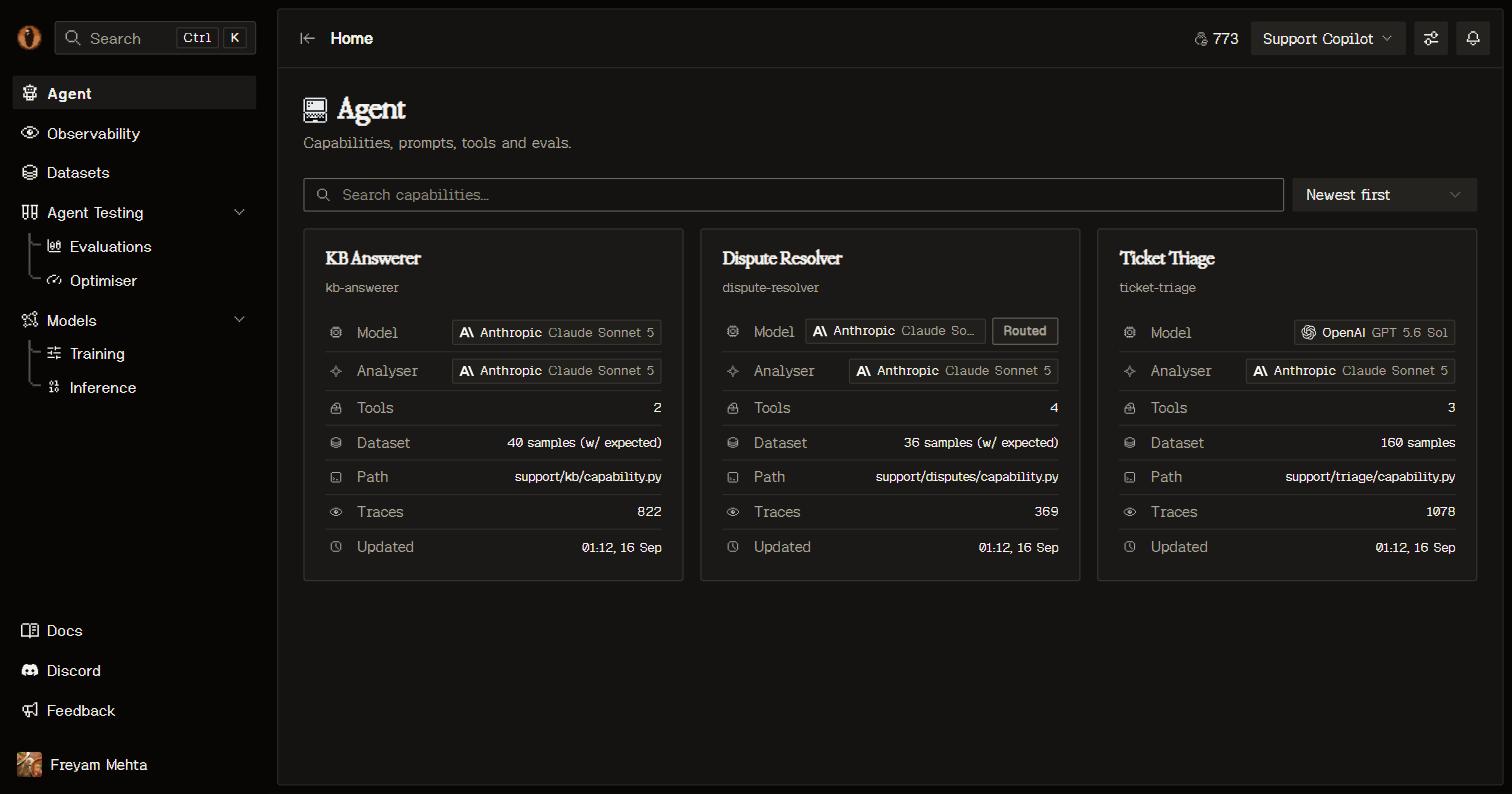 The header carries the name (editable in place), copyable **capability id** and **project id** chips, the slug, and the **Not in latest scan** and **Observed** badges when they apply. **View traces** opens the capability's filtered Observability view. Below it, one scrolling page:
* **Facts** — the model the capability serves through (or the live deployed model behind its alias) and its source path.
* **Prompt** — the system prompt lifted from your code, one per mode when the capability has several.
* **Trajectory map** — the entry point, each behaviour's steps with the tools they may use, and its terminal, as an interactive graph.
* **Components** — every anchor, tool and utility the scan found, with file-level provenance.
* **Dataset** — datasets aligned to this capability. See [Datasets](/core/datasets).
* **Eval metrics** — the capability's eval sets and evaluators, with score history over its runs. See [Eval](/agent-testing/eval).
* **Models** — the production model and any models trained on this capability's data, linking into [Models](/models/training) and [Inference](/models/inference).
The header carries the name (editable in place), copyable **capability id** and **project id** chips, the slug, and the **Not in latest scan** and **Observed** badges when they apply. **View traces** opens the capability's filtered Observability view. Below it, one scrolling page:
* **Facts** — the model the capability serves through (or the live deployed model behind its alias) and its source path.
* **Prompt** — the system prompt lifted from your code, one per mode when the capability has several.
* **Trajectory map** — the entry point, each behaviour's steps with the tools they may use, and its terminal, as an interactive graph.
* **Components** — every anchor, tool and utility the scan found, with file-level provenance.
* **Dataset** — datasets aligned to this capability. See [Datasets](/core/datasets).
* **Eval metrics** — the capability's eval sets and evaluators, with score history over its runs. See [Eval](/agent-testing/eval).
* **Models** — the production model and any models trained on this capability's data, linking into [Models](/models/training) and [Inference](/models/inference).
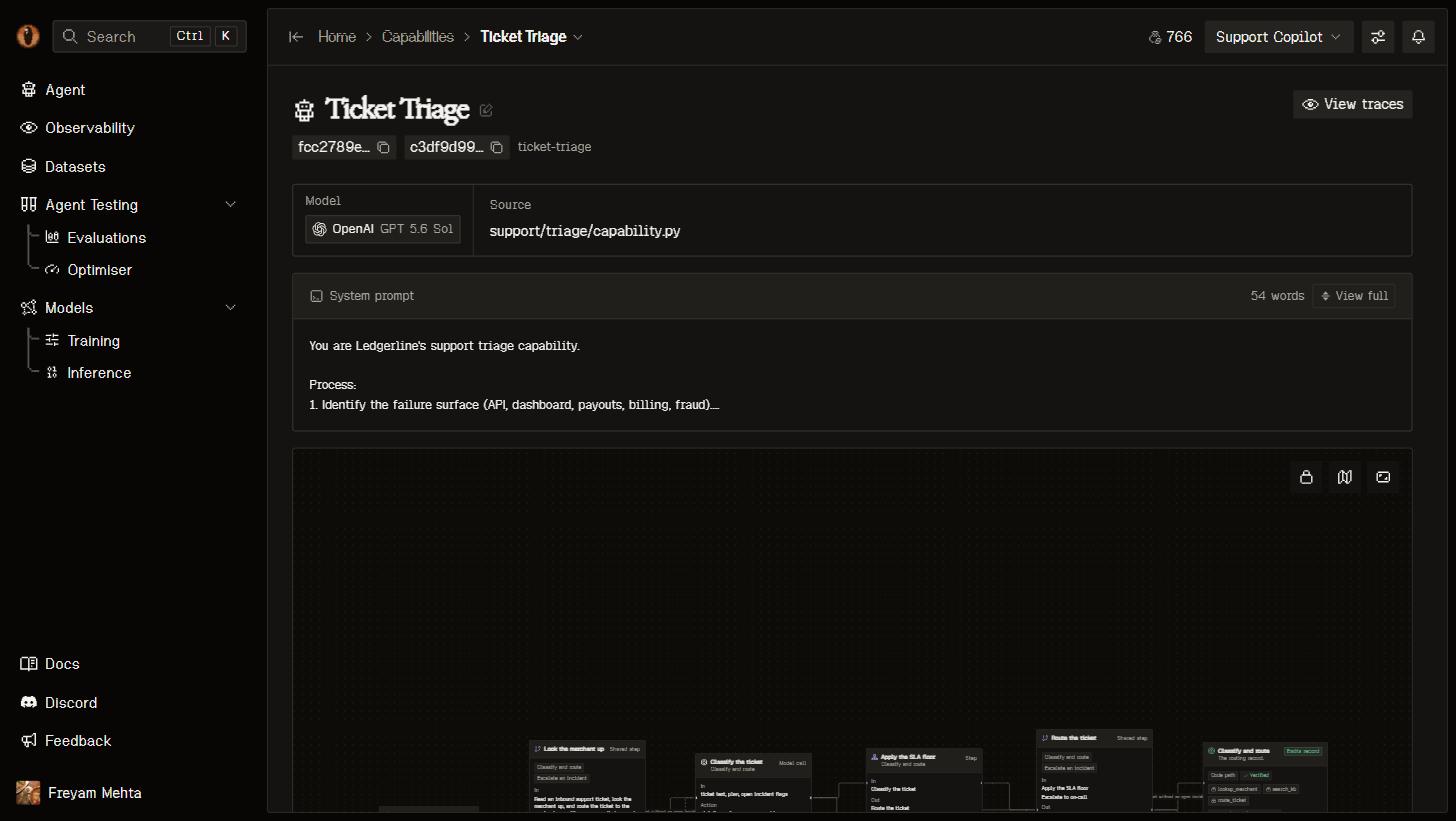
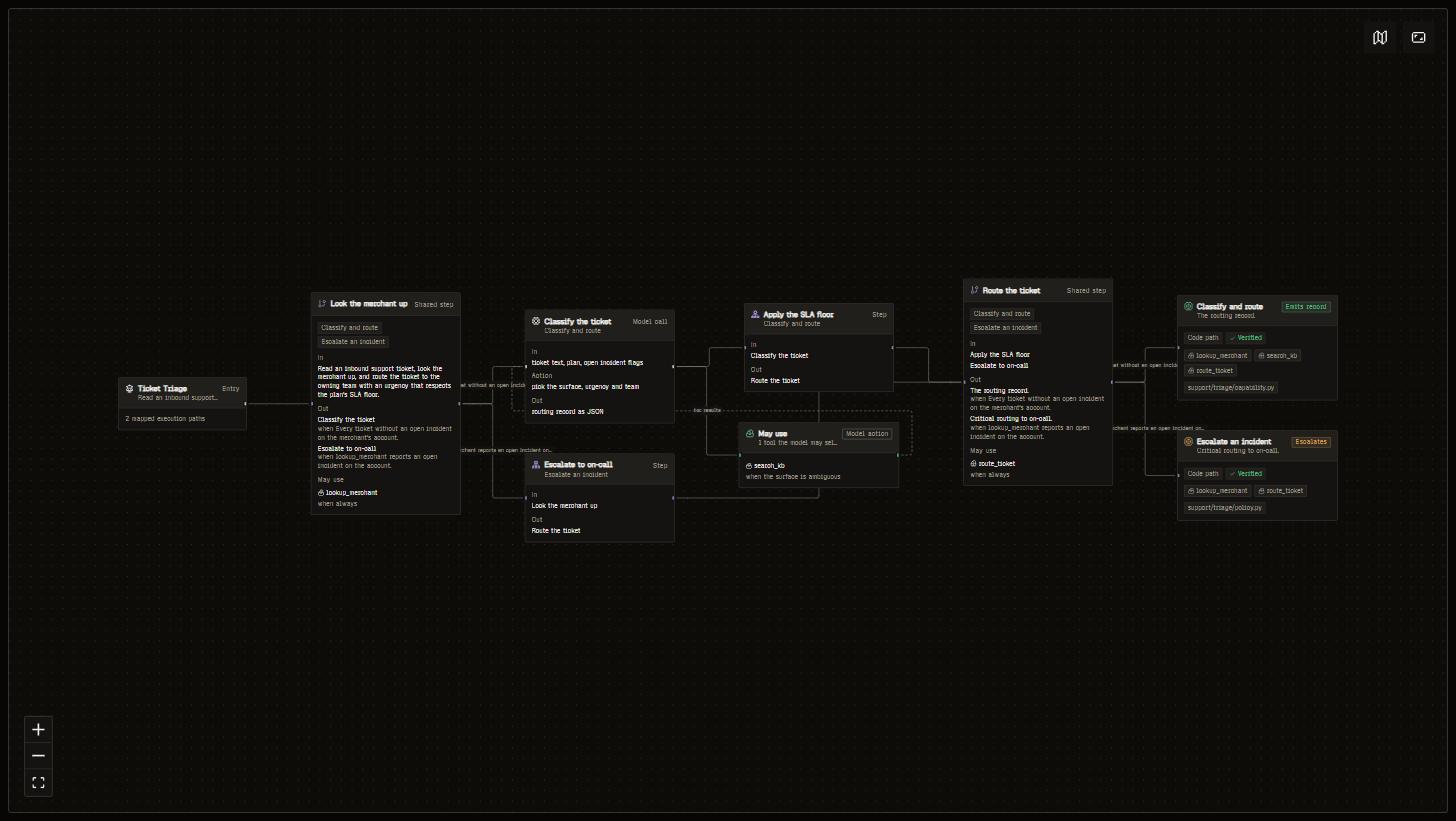 The Agent page is the record of the latest sync: each capability with its card and behaviours.
## Instrumentation
Which of a capability's anchors emit telemetry is answered by the traces themselves: a task execution's route shows the contract anchors it matched, and a behaviour with no executions has none. To close a gap, ask your coding agent: the `get_instrumentation_plan` MCP tool returns placement tickets (file, qualname, decorator, required scope) for the project or one capability, and `verify_instrumentation` grades a fresh trace against the contract without writing anything. The `/overmind ensure-tracing` command runs that loop. See [MCP](/platform/mcp).
## API
```bash theme={null}
# The whole agent graph: current capabilities, their edges, and the latest scan
curl -H "X-Api-Key: $OVERMIND_API_KEY" "https://api.overmindlab.ai/api/agent/?project={project_id}"
# List capabilities / one capability
curl -H "X-Api-Key: $OVERMIND_API_KEY" "https://api.overmindlab.ai/api/capabilities/"
curl -H "X-Api-Key: $OVERMIND_API_KEY" "https://api.overmindlab.ai/api/capabilities/{id}/"
# The evaluation spec and the selectable system prompts
curl -H "X-Api-Key: $OVERMIND_API_KEY" "https://api.overmindlab.ai/api/capabilities/{id}/eval_spec/"
curl -H "X-Api-Key: $OVERMIND_API_KEY" "https://api.overmindlab.ai/api/capabilities/{id}/prompts/"
# Behaviours and how well the eval set covers each one
curl -H "X-Api-Key: $OVERMIND_API_KEY" "https://api.overmindlab.ai/api/behaviours/"
curl -H "X-Api-Key: $OVERMIND_API_KEY" "https://api.overmindlab.ai/api/behaviours/coverage/?capability={id}"
# Pull the reconciled snapshot (leftovers come back archived)
curl -H "X-Api-Key: $OVERMIND_API_KEY" "https://api.overmindlab.ai/api/v1/sync?project_id={project_id}"
```
`GET /api/capabilities/` returns current capabilities unless `?status=` asks for leftovers. `PATCH /api/capabilities/{id}/` updates mutable fields, including `model`. Writing `active_model` starts a persisted activation that verifies inference before switching the alias; read `activation` for progress and errors. The existing selection remains active until verification succeeds. `POST /api/v1/sync` is what `overmind sync` speaks; it takes API-key auth and requires `project_id` to be in the key's scope (a project-scoped key supplies its one project). Through MCP: `inspect_capability_health`, `query_failures`, and the `overmind://capabilities/{capability}` resource. See the [REST API](/platform/api) for the full surface.
## Good to know
* **The baseline matters.** The capability's `model` field is what training benchmarks and optimiser baselines measure against. The card is where the model gets named when the codebase resolves models through a role chain rather than a literal.
* **Commit `overmind.toml`.** It carries the ids and the authored cards that keep identity and semantics stable across syncs. `.overmind/credentials.toml` holds the project key and is excluded from git by `overmind sync`.
* **Pin identity in code.** `overmind.init(capability_id="")` or a `capability(..., id=)` scope stamps `overmind.capability.id` on every span inside. Ingest binds by that id alone.
This documentation is built and hosted on [Mintlify](https://mintlify.com), a developer documentation platform.
The Agent page is the record of the latest sync: each capability with its card and behaviours.
## Instrumentation
Which of a capability's anchors emit telemetry is answered by the traces themselves: a task execution's route shows the contract anchors it matched, and a behaviour with no executions has none. To close a gap, ask your coding agent: the `get_instrumentation_plan` MCP tool returns placement tickets (file, qualname, decorator, required scope) for the project or one capability, and `verify_instrumentation` grades a fresh trace against the contract without writing anything. The `/overmind ensure-tracing` command runs that loop. See [MCP](/platform/mcp).
## API
```bash theme={null}
# The whole agent graph: current capabilities, their edges, and the latest scan
curl -H "X-Api-Key: $OVERMIND_API_KEY" "https://api.overmindlab.ai/api/agent/?project={project_id}"
# List capabilities / one capability
curl -H "X-Api-Key: $OVERMIND_API_KEY" "https://api.overmindlab.ai/api/capabilities/"
curl -H "X-Api-Key: $OVERMIND_API_KEY" "https://api.overmindlab.ai/api/capabilities/{id}/"
# The evaluation spec and the selectable system prompts
curl -H "X-Api-Key: $OVERMIND_API_KEY" "https://api.overmindlab.ai/api/capabilities/{id}/eval_spec/"
curl -H "X-Api-Key: $OVERMIND_API_KEY" "https://api.overmindlab.ai/api/capabilities/{id}/prompts/"
# Behaviours and how well the eval set covers each one
curl -H "X-Api-Key: $OVERMIND_API_KEY" "https://api.overmindlab.ai/api/behaviours/"
curl -H "X-Api-Key: $OVERMIND_API_KEY" "https://api.overmindlab.ai/api/behaviours/coverage/?capability={id}"
# Pull the reconciled snapshot (leftovers come back archived)
curl -H "X-Api-Key: $OVERMIND_API_KEY" "https://api.overmindlab.ai/api/v1/sync?project_id={project_id}"
```
`GET /api/capabilities/` returns current capabilities unless `?status=` asks for leftovers. `PATCH /api/capabilities/{id}/` updates mutable fields, including `model`. Writing `active_model` starts a persisted activation that verifies inference before switching the alias; read `activation` for progress and errors. The existing selection remains active until verification succeeds. `POST /api/v1/sync` is what `overmind sync` speaks; it takes API-key auth and requires `project_id` to be in the key's scope (a project-scoped key supplies its one project). Through MCP: `inspect_capability_health`, `query_failures`, and the `overmind://capabilities/{capability}` resource. See the [REST API](/platform/api) for the full surface.
## Good to know
* **The baseline matters.** The capability's `model` field is what training benchmarks and optimiser baselines measure against. The card is where the model gets named when the codebase resolves models through a role chain rather than a literal.
* **Commit `overmind.toml`.** It carries the ids and the authored cards that keep identity and semantics stable across syncs. `.overmind/credentials.toml` holds the project key and is excluded from git by `overmind sync`.
* **Pin identity in code.** `overmind.init(capability_id="")` or a `capability(..., id=)` scope stamps `overmind.capability.id` on every span inside. Ingest binds by that id alone.
This documentation is built and hosted on [Mintlify](https://mintlify.com), a developer documentation platform.